
Broward Strength & Performance
Double the revenue in one month.
Reported result following the website redesign and SEO/AEO work. Reflects the overall engagement.
See results and case study →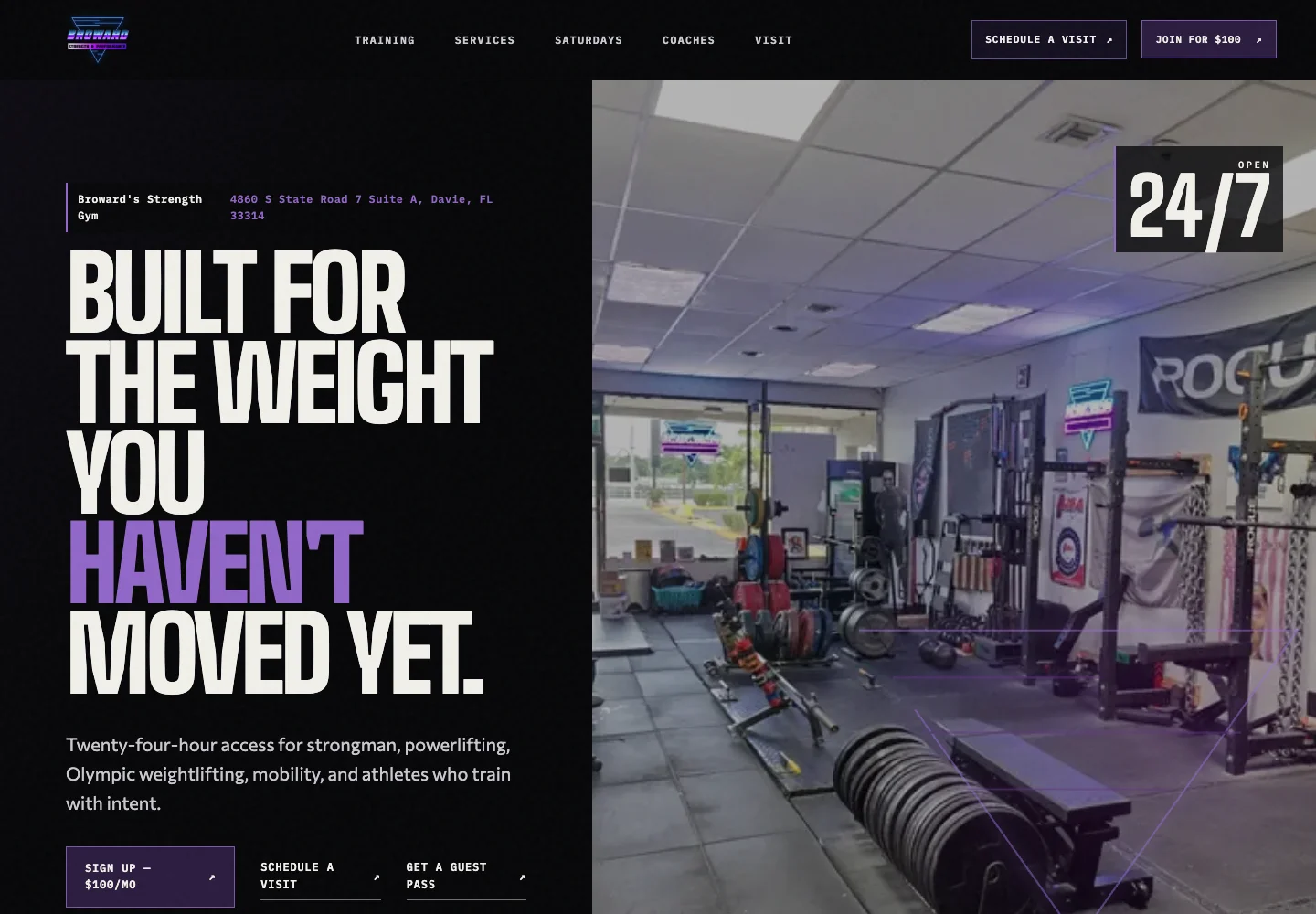
Field notes
Practical perspectives on building better websites, choosing software, and putting AI to work for your business.
Broward Strength & Performance
Reported result following the website redesign and SEO/AEO work. Reflects the overall engagement.
See results and case study →ProCare Consulting · AI agent & automation
ProCare can keep prospecting and follow-up moving without the team coordinating every step by hand. That gives advisors more room to help people understand their Medicare options and make informed coverage decisions.
Read the ProCare case study →Customer experiences
Read our customers’ experiences on our Google Business profile.
Featured field note
Search Visibility
7 min read
SEO helps people discover a business through search. AEO helps modern answer engines interpret the business accurately. Both depend on the same discipline: clear, useful, trustworthy information.
Start with the questions customers ask before they choose a provider. Build focused pages that answer those questions with real detail, clear service boundaries, and a practical next step. Then make the foundation easy to crawl and navigate: sensible page titles, fast pages, logical internal links, structured data that matches visible content, and consistent business information. Do not chase shortcuts or assume a mention in an answer engine can be guaranteed. The durable advantage is a site that gives people and systems a reliable source of truth about what you do, who you help, and why they should care.
The best AI systems do not treat privacy as a final review. They make it part of the architecture, workflow, and definition of success from the beginning.
Start by defining the business outcome and the minimum data needed to achieve it. Classify sensitive information before connecting an AI model, choose vendors and contracts that fit the data, and prevent customer information from being reused for model training unless that use is clearly approved. Give systems the least access required, separate testing from production, encrypt data in transit and at rest, and keep audit logs that show what the system accessed and changed. High-impact actions should require human approval, while retention and deletion rules should be designed before launch. For healthcare and other regulated work, privacy also requires a documented risk analysis, appropriate safeguards, and the right vendor agreements. The goal is not to weaken AI. It is to build a system people can trust, measure, and safely improve.
The right first project is not always an automation. It might be a customer portal, a mobile app, a better website, an internal tool, or an AI workflow.
Start with the outcome, not the technology. If manual work is slowing the team down, automate it. If customers need a better way to buy, book, or get support, build the experience they are missing. Choose one important problem, define what success means, and ship the smallest complete solution that can prove its value.
An app gives people a place to complete work. An automation moves information and actions behind the scenes. Strong systems often combine both.
Build an app when customers or employees need a clear interface, account, dashboard, or repeatable experience. Use automation when the real problem is handoffs, duplicate entry, delays, or disconnected software. If users need control while the system handles routine work, the best answer is usually a focused application supported by automation.
Spreadsheets are useful until they become the database, workflow, reporting system, and source of truth for the entire company.
Watch for duplicate files, broken formulas, manual status updates, unclear ownership, and reports that take hours to assemble. Those are signs the business needs a shared system with permissions, validation, history, and automation. Custom software becomes worthwhile when the cost of working around the spreadsheet is higher than replacing it.
A custom app should create an advantage that generic software cannot provide, not simply recreate tools that already work.
The strongest app ideas improve a core customer experience, turn a unique process into a repeatable system, or connect information that is currently fragmented. Before building, identify the primary user, the action they need to complete, and the business result that action should create. That keeps the first release focused and useful.
Automation follows defined rules. An AI agent can interpret information, make limited decisions, and take approved actions across connected systems.
Most businesses need both. Rules are ideal for predictable work such as routing forms or sending confirmations. AI becomes useful when the work includes unstructured messages, documents, research, or judgment. The right system combines them with clear controls, reliable fallbacks, and human approval where it matters.
A website helps people understand and trust your business. A web app lets them sign in, complete tasks, manage information, or use a service.
Choose a website when the priority is positioning, discovery, content, and conversion. Choose a web app when users need accounts, dashboards, transactions, or personalized workflows. Many growing companies need both: a focused marketing site that creates demand and a secure product experience that delivers the service.